
Revitalising Your Career After Age 40: 5 Ways to Use SkillsFuture Credit at SIM
Hitting 40 often sparks a career crossroads. While you’ve accumulated valuable professional expertise over the years, digital transformation, AI, and evolving business landscapes continually create new industry skill demands.
For Singapore Citizens, SkillsFuture Credit can make mid‑career learning more accessible by helping to offset eligible course fees. At SIM Academy, working adults can explore professional development courses across various areas. Read on to find five practical ways to redeem your SkillsFuture Credit here.

06 September 2026

Mid‑career learning can help professionals connect their existing experience with new workplace capabilities.
What Is SkillsFuture Credit?
SkillsFuture is a national movement in Singapore that supports lifelong learning and skills development. SkillsFuture Credit is a dedicated credit that Singapore Citizens can use to offset out‑of‑pocket fees for eligible training programmes.
All Singapore Citizens aged 25 and above receive an opening SkillsFuture Credit of S$500, which does not expire and can be used to submit a claim for various courses offered. To support mid‑career workers, Singapore Citizens aged 40 and above also receive a SkillsFuture Credit (Mid‑Career) of S$4,000. This mid‑career credit does not expire and can be used for selected courses that support better employability outcomes.
Why Does SkillsFuture Credit Matter After 40?
After 40, career development hinges on updating how you apply your years of experience. A finance manager may need better data interpretation skills. An operations lead may need stronger project management knowledge. A senior executive may need to understand how AI affects business decisions, governance and risk. Continuous upskilling keeps you adaptable amid workplace changes.
Here are the key focuses for mid‑career professionals:
| Professional Dimension | Mid‑Career Focus After 40 |
|---|---|
| Career objective | Strengthening long‑term relevance, leadership and adaptability |
| Learning need | Cross‑functional management, digital fluency and strategic thinking |
| Professional value | Judgement, stakeholder management, mentorship and business acumen |
| Funding consideration | More deliberate use of SkillsFuture Credit and other funding options |
5 Ways to Use SkillsFuture Credit at SIM
SIM Academy offers more than 100 professional development courses across various areas. Learners who are planning to use SkillsFuture Credit should begin with the SIM SkillsFuture courses overview and confirm the latest eligibility before registration.
1. Strengthen Leadership and People Management Skills
Many professionals move into broader responsibilities after years of technical or functional experience. This shift requires more than expertise in a single job scope. It often calls for stronger people management, clearer communication, better delegation and the ability to motivate teams across different experience levels.
At SIM Academy, learners can explore INFLUENCE (INTERMEDIATE), a course designed for supervisors, executives, and managers. The course focuses on workplace influence and persuasion, helping learners communicate ideas more effectively and build trust.
Leadership training is suitable for professionals stepping into team lead, managerial or department leadership roles, helping seasoned staff build structured leadership from their practical experience.

2. Build Digital and Data Readiness
All managers across departments now need data literacy to guide business decisions and manage risks. Although Mid‑career professionals do not always need to become programmers to stay relevant, they should learn to utilise digital tools for informed judgments and assess implementation risks.
SIM Academy offers Data Visualisation Using Power BI, designed for executives, supervisors and managers who work with data in Microsoft Excel but need more powerful tools for analysis and visual presentation. The course focuses on using Microsoft Power BI to create dashboards, present business information through suitable charts and communicate insights clearly.
This learning direction is useful for professionals who want to participate more effectively in performance reviews, business planning, and digital transformation discussions.
3. Upgrade Communication, Presentation and Stakeholder Management Skills
As professionals advance into leadership roles, their work often depends less on completing tasks alone and more on influencing others. Presenting ideas clearly, managing stakeholders and navigating difficult conversations can directly affect project momentum, team alignment and business outcomes.
SIM Academy courses such as Strategic Communication Mastery for Leaders are designed for senior and aspiring leaders who want to craft persuasive narratives, manage stakeholders and lead complex conversations with clarity.
This matters most for cross‑departmental staff presenting to leaders. Good communication complements technical skills, making your insights clearer and more actionable.
| Communication Skill | Workplace Application | Possible Professional Value |
|---|---|---|
| Executive storytelling | Presenting project proposals and business cases | Helps decision‑makers understand the value of an idea |
| Stakeholder mapping | Planning communication across teams and departments | Supports alignment before decisions are made |
| Difficult conversations | Handling disagreement, feedback and change | Reduces misunderstanding and supports trust |
| Persuasive communication | Explaining technical or strategic information | Makes complex ideas more accessible to different audiences |
4. Prepare for Role Expansion with Project Management Skills
Some professionals use their 40s to take on broader responsibilities within their current organisation, leveraging additional SkillsFuture Credit for further training. For professionals who want to strengthen this capability, SIM Academy offers Project Management Professional (PMP)® (L4) (SFW). The course is designed to help learners prepare for the PMP certification exam.
This pathway can be useful for mid‑career professionals who already have workplace experience but want to manage projects with greater structure and confidence. For example, a department supervisor can learn to coordinate end‑to‑end cross‑functional system upgrade projects.
5. Use SCTP to Support a Mid‑Career Switch
Years of workplace experience remain valuable, but a successful career switch often requires more than experience alone. Mid‑career professionals may also need updated industry knowledge, practical training and clearer evidence that they are ready to move into a different role or sector.
For professionals who are planning a career transition, SIM’s SkillsFuture Career Transition Programme (SCTP) is designed to support individuals who want to change to a different role or pivot to another industry. These industry‑aligned programmes typically range from three to six months and combine skills training with career support.
Through SCTP, you can build practical capabilities for selected in‑demand areas while receiving career‑preparatory support. If you are aged 25 and above, you may use SkillsFuture Credit. If you are an eligible Singaporean aged 40 and above, you may also use the SkillsFuture Credit (Mid‑Career) top‑up, subject to the latest funding conditions.
How to Choose the Right SkillsFuture Course for Your Career Goal
Assess Your Current Skills Gap
Start by reviewing your current responsibilities and identifying where you depend too heavily on others. This could include data interpretation, digital tools, stakeholder communication, team management, project planning or strategic decision‑making.
Performance reviews, manager feedback and recent project challenges can also show where your next learning priority should be. A specific skills gap is easier to act on than a general feeling that you need to “upgrade”.
Align Courses with Singapore Industry Trends
Course choice should also reflect the direction of the Singapore economy and your sector. Digital transformation, sustainability, workforce planning, AI adoption and service innovation are areas where many organisations continue to review their capabilities.
SIM Academy groups courses into digital, leadership, sustainability and more, helping you match training to short‑term work demands and long‑term career goals.
Consider Learning Format and Time Commitment
Mid‑career learners often balance work, family and other commitments. A short workshop may suit a targeted skill need, while a longer programme may be more suitable for career transition or deeper reskilling.
Before registering, check the course duration, schedule, delivery format, assessment requirements, funding eligibility and claim process. This helps you avoid choosing a course that looks relevant but is not realistic for your current schedule.
| Learning Objective | Suitable Course Type | Possible Focus Area at SIM Academy |
|---|---|---|
| Immediate upskilling | Short course or workshop | Communication, presentation, digital tools or leadership fundamentals |
| Role expansion | Professional development course | People management, project management or strategic thinking |
| Career transition | Longer structured programme | SkillsFuture Career Transition Programme or selected reskilling pathways |
| Leadership refresh | Executive‑focused course | Stakeholder management, AI readiness, systems thinking or innovation |
How to Use SkillsFuture Credit for a Course
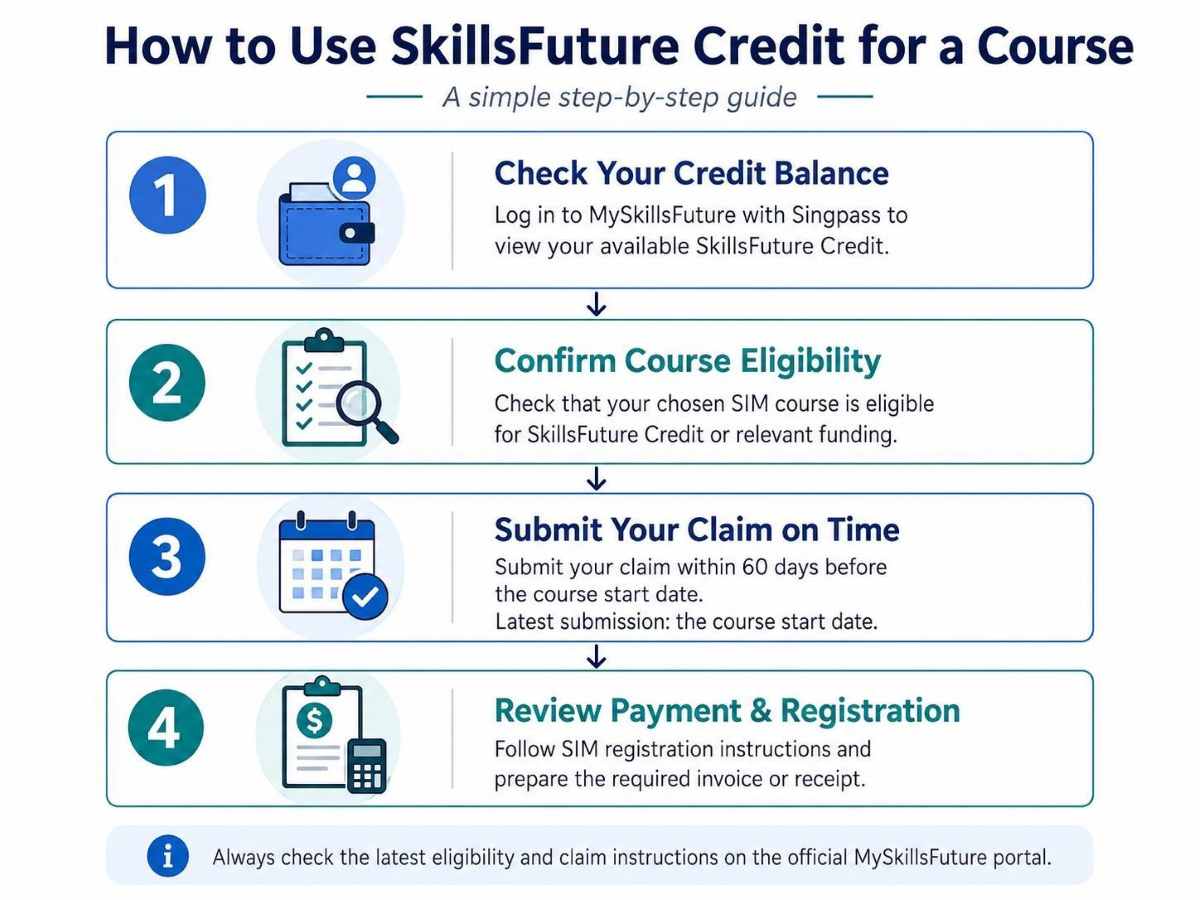
Step 1: Check Your SkillsFuture Credit Balance
Log in to the MySkillsFuture portal using Singpass to check your available SkillsFuture Credit balance. This helps you understand how much credit may be available before you commit to a course.
Step 2: Confirm Course Eligibility
Not every course is eligible for SkillsFuture Credit or SkillsFuture Funding. Review the course details on the SIM Academy and confirm the latest eligibility through the official MySkillsFuture portal before registering.
Step 3: Submit Your Claim on Time
According to MySkillsFuture, learners can submit a SkillsFuture Credit claim from 60 days before the course start date, and the latest submission date is the course start date, ensuring Singaporeans can easily access their benefits. Learners should also inform the training provider that they intend to use SkillsFuture Credit and prepare the required supporting documents, such as the invoice or receipt.
Step 4: Check Payment and Registration Instructions
Before making payment, review SIM Academy’s registration and payment instructions. This is important because learners should not pay the portion of the course fee that they intend to claim with SkillsFuture Credit unless instructed otherwise by the training provider or official claim process.
Conclusion
Revitalising your career after 40 is a practical way to keep your experience relevant in a changing workplace. SkillsFuture Credit can help Singapore Citizens reduce out‑of‑pocket learning costs, while SIM Academy offers professional development pathways across leadership, digital, communication, project management and career transition areas. Explore SIM Academy’s SkillsFuture Credit eligible courses to find a programme that fits your career goals, schedule and next stage of professional growth.