Bachelor of Science (Business Administration and Geographic Information Science)

University at Buffalo

Programme Overview

Academic Level
Academic Level

Bachelor's Degree, double major

Awarded by
Awarded by

University at Buffalo, The State University of New York, US

Programme type
Programme type

Full-time, 4 years

Campus location
Campus location

SIM Campus

Application Dates
Application Dates

Now till 30 March 2026 (May (Summer) 2026 Intake)

Estimated Fees (incl. GST)
Estimated Fees

(incl. GST)*

S$60,887.40 - S$84,496.80 (Singaporean & PR) / S$67,296.60 - S$93,391.20 (International student)

* Exclude application fee, preparatory or bridging course fee, and other fees. Refer to the Fees & Financial Aid section for details.

Bachelor of Science (Business Administration and Geographic Information Science), University At Buffalo


Programme Outline

Awarded and developed by: University at Buffalo, The State University of New York, US

As a Business major, you will learn insights and skills about the business world and have the option to choose from one of the four concentrations offered – financial analysis, international business, marketing or operations and supply chain.

The Bachelor of Science (Geographic Information Science) degree:

  • provides students with cutting-edge knowledge, skills, and abilities in using geospatial sciences, and this includes geographical information systems (GIS), remote sensing, locational analysis, and geographic visualization.
  • focuses on the theoretical foundations of geographical information science, the development and use of state-of-the-art software and emerging technology, and the collection, processing, and interpretation of geospatial information.

As the use of geospatial technology and GIS in society is widespread, demand for these skills in public and private sectors remains high and continues to grow, offering students diverse career opportunities.

  • The SIM-UB scholarship allows deserving students at SIM to spend one semester at the UB’s New York campus.
  • The Business Administration program is accredited by AACSB International.

SIM-UB Newsletters

 
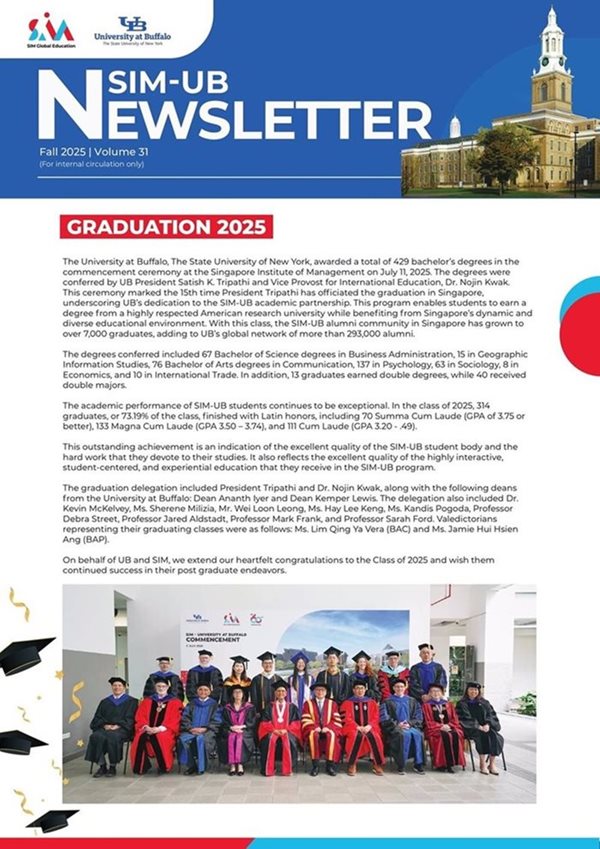
Fall 2025

Read More 
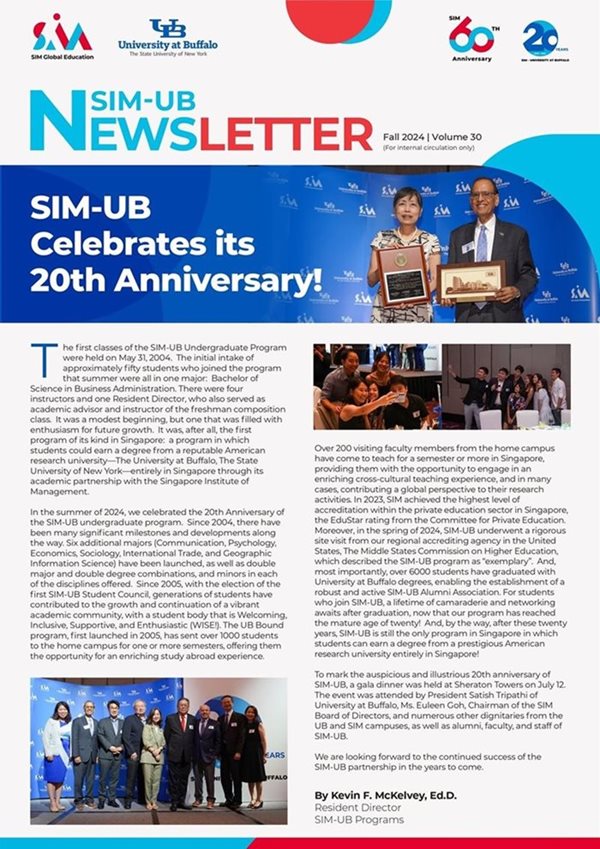
Fall 2024

Read More
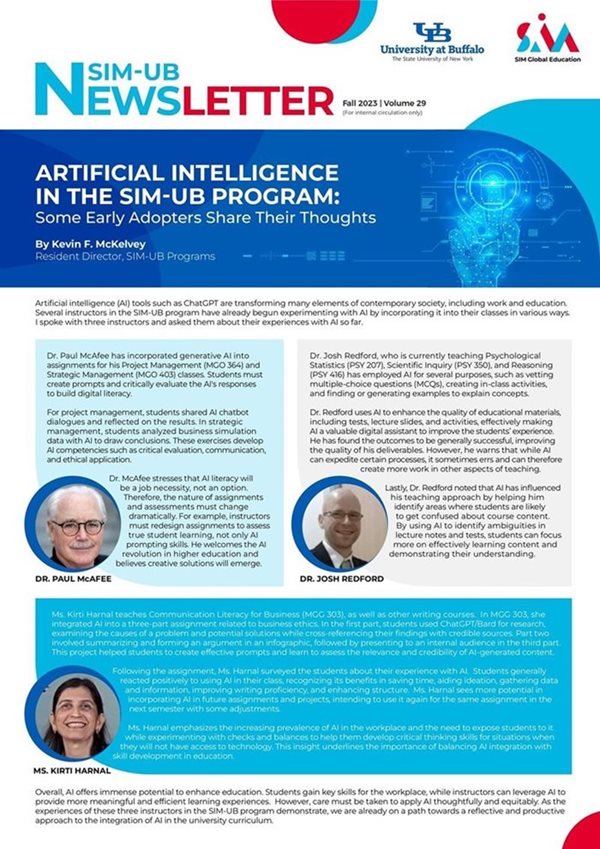
Fall 2023

Read More


learning-outcome

Learning Outcomes

Upon successful completion of this programme, you will:

  1. Gain a broad foundation of knowledge essential in the industry
  2. Understand the role of the business firm in society
  3. Learn about the management functions of planning and controlling
  4. Learn about the behavior of organizations and tools of modern management
  5. Be proficient in collecting, describing, analyzing, interpreting, and visualizing patterns, processes, and interactions of geospatial phenomena including the environment, human activities, and their interactions in time and space.
  1. Develop skills in using state-of-the-art geospatial software and technologies employed in research, industry, and government agencies.
  2. Be equipped with theoretical and practical experience in solving geospatial problems in a variety of geographic realms including the environment, health, cities, and social media.

Further Studies & Career Prospects

Graduates have gone on to graduate schools for further studies in the areas such as Psychology, Law, Public Policy, School Administration, Information Science, Political Science and Sociology.

Founded in 1923, the Business Administration program is accredited by AACSB International – The Association to Advance Collegiate Schools of Business. Accreditation by AACSB is considered the hallmark of management education. Of the more than 8,000 business schools in the world, only 529 are currently accredited by the AACSB.

With these double major qualifications, you have better job opportunities in

  • Banking & finance
  • Credit, risk & asset management
  • HR & Organization Development
  • Production Planning
  • Cartographer
  • Climatologist
  • Computer analyst
  • Ecologist
  • Environmental scientist/manager
  • Geomorphologist
  • GIS specialist
  • Health care
  • Market research analyst
  • Meteorologist
  • Natural resource manager
  • Researcher
  • Urban and transportation planner
  • Other professions 

Learn about GIS career opportunities in Singapore

Hear from our students
Balancing Multiple Paths: How a SIM–University at Buffalo Student Is Growing Through Sport, Study, and Leadership

Muhammad Raziq, a psychology student at SIM–University at Buffalo, balances academics, national tchoukball competition, coaching, and technical officiating. From starting the sport at nine to mentoring young athletes and competing internationally, his journey is defined by discipline, empathy, and adaptability, supported by SIM’s flexible academic environment that allows him to manage multiple responsibilities and grow both on and off the court.

Read story

Why study at SIM x University at Buffalo

uni-at-buffalo-leading-private-edu
SIM is the leading private education institution in Singapore.
uni-at-buffalo-excellent-value
Excellent value with lower tuition costs in SIM, with opportunities for overseas exchange and transfer.
uni-at-buffalo-high-quality
Enjoy a high-quality and interactive American education.
uni-at-buffalo-regular-ub-students
Students admitted are regular UB students (no distinction between Singapore and Buffalo)
Learn more about the University at Buffalo

Intake Dates

2026 Summer (May) Intake

PROGRAMME DURATION

25 May 2026 to April 2030

APPLICATION PERIOD

Open Now
to 30 March 2026

2026 Fall (August) Intake

PROGRAMME DURATION

24 August 2026 to July 2030

APPLICATION PERIOD

Open from 14 April 2026
to 29 June 2026

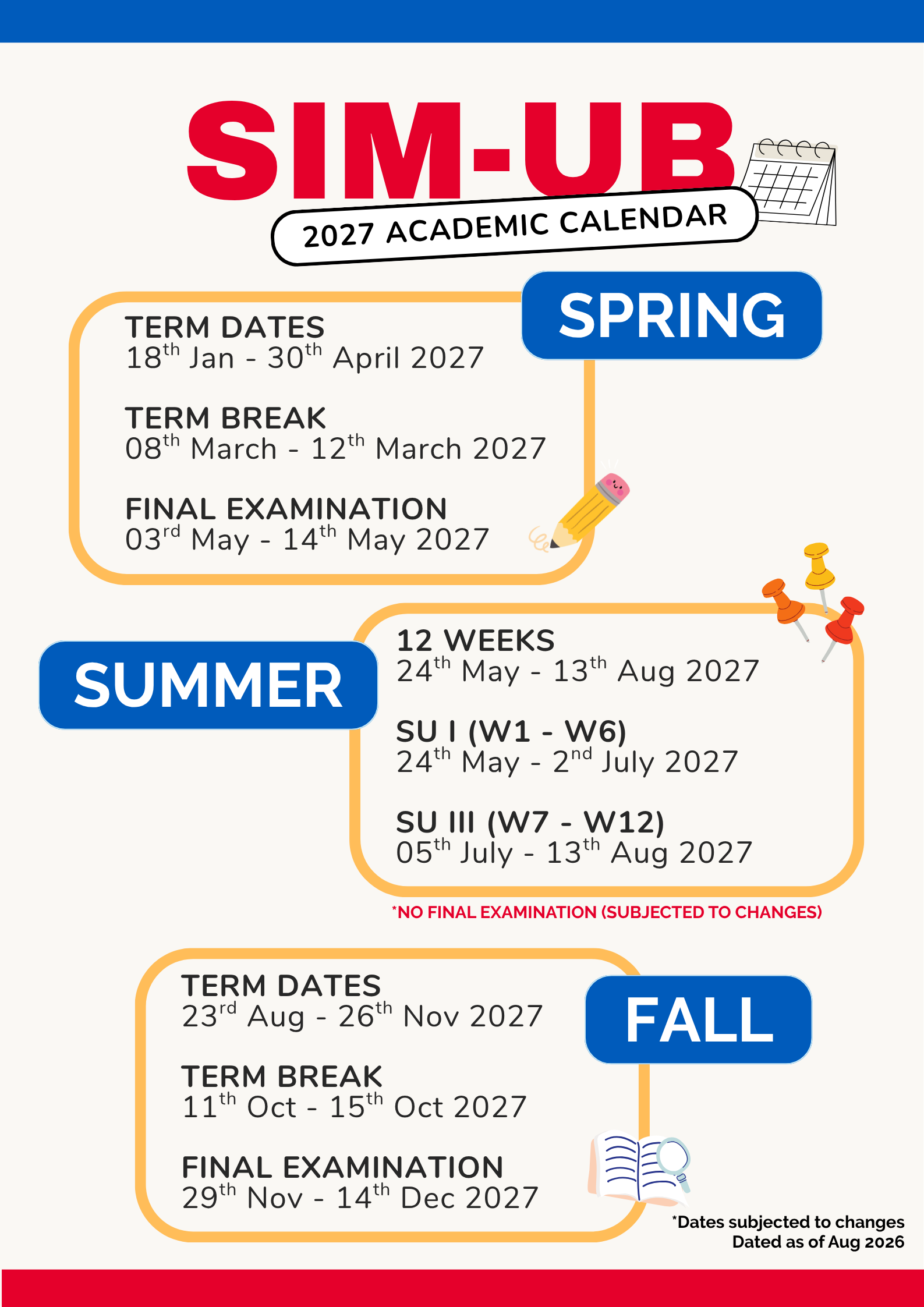
View Academic Calendar

Full-time course is over 12 semesters (3 per year) and can be completed in 4 years for double major or double degree programs. Each semester is 12-15 weeks.


Maximum allowed period to complete:
Double major / double degree program – 8 years
If a student fails to complete the course within the candidature period, they will not be entitled to any recourse or refund.

Curriculum

Structure

  • Blended Learning. Activities, consultations, discussions, exercises, lectures, online learning and presentations.
  • Each lesson consists of 1.5 hours of lecture and 1.5 hours of consultation.
  • To ensure parity in standards, rigors of the program, integrity of the UB degree, more than 50% of modules are taught by US/overseas visiting faculty, covering the full semester throughout the entire program. The rest of the modules are taught by qualified local faculty with the experience and academic expertise approved by UB.
  • Average teacher-student ratio = 1:42
  • Minimum class size to commence: 25 students. Students will be informed at least one month prior to course commencement if class cannot commence due to low take up rate.

View a list of lecturers’ teaching modules (PDF 452 KB)

Assessment & Attendance

  • The normal module load for students is 12 to 15 credit hours a semester.
  • Students may register for modules and make changes to their class schedule. Students who choose to drop or resign from any modules, are on official leave of absence or have to repeat any failed modules, may take more than three years to complete their studies.
  • Continuous assessment comprises tests, quizzes, assignments, projects, presentations, participations and activities scheduled throughout the semester.
  • The final exam is held in the 2 - 3 weeks after the semester ends.
  • Students progress through each semester till they satisfactorily complete the conferral requirements.
  • Attendance requirement:
    • Local students – Minimum attendance requirement as stipulated by UB or 75%, whichever is higher.
    • International students – Minimum attendance requirement is 90% as mandated by the Immigration and Checkpoints Authority of Singapore (ICA).

Requirements to Graduate

  • Completion of min. of 120 credits with a min. overall and UB GPA of 2.0 to be awarded the degree.
  • With the credit exemptions, students may be able to complete the course of study in less than 3 years.
  • Students who successfully complete all the requirements of the program will be awarded the Bachelor of Arts and/or Science degree in the relevant major(s) by the University at Buffalo, The State University of New York, US.
  • Students earning baccalaureate degrees are eligible to receive Latin Honors based on their UB cumulative GPA on the following scale:
    Average (based on 4.0 = A)
    • 3.20 cum laude (Distinction)  
    • 3.50 magna cum laude (High Distinction)  
    • 3.75 summa cum laude (Highest Distinction)  


    To qualify for Latin Honors, students must present a minimum of 60 credits of UB undergraduate coursework, at least 54 of which must be graded credits (i.e. not satisfactory or unsatisfactory – grades of ‘S’ or ‘U’)

Modules


Total credits required for degree: 134-136

Credits Required for Major: 105
Credits Required for UB Curriculum: 29-31
Credits Required for Free Electives (Any Level): 0
Credits Required for Free Electives (Upper Division, at least 300-Level): 0

MGG 150 Business and Society (3 credits)
Comprehensively provides a broad understanding of business, including various functions and their interrelationships; terminology; management fundamentals and competitive factors; legal and ethical issues; and consideration of various external elements, including society at large. Required for School of Management majors and Management minors.
   
MTH 131 Mathematical Analysis for Management (4 credits)
For students in Management. Limits, continuity, differentiation of algebraic and exponential functions. Applications, partial derivatives and applications. Introduces integration.
   
PSY 101 Introductory Psychology (3 credits)
General survey of perception; learning and memory; cognitive, developmental, personality, abnormal, and social psychology; and behavioral neuroscience. Requires participation in research or a short paper.
   
ECO 181 Introduction to Macroeconomics (4 credits)
This course provides an overview of the fundamental economic principles and economic measures used to evaluate the economy, such as gross domestic product, the inflation rate, the unemployment rate, and federal deficits. The course examines how the economy functions, what causes economic difficulties, and the policies that are used to improve the functioning of the economy. This course may be taken independently of ECO 182.
   
ECO 182 Introduction to Microeconomics (4 credits)
This course provides an overview of how individuals and firms make decisions regarding the allocation of scarce resources to maximize the value they obtain from these resources. The course also looks at how markets are structured and how resource scarcity has caused markets to evolve. Finally, it addresses the debate on whether regulating markets can improve their functioning. This course may be taken independently of ECO 181.
   
MGA 201 Introduction to Financial Accounting (3 Credits)
The first course in accounting presents the underlying framework and concepts of financial accounting systems essential to the preparation, understanding, and interpretation of accounting information in the contemporary business environment. Topics examined include those related to recording business transactions, reporting corporate financial position, operating results, and cash flows, and analyzing financial strength. The impact on financial markets and society due to limitations of financial statements and lapses in ethical reporting are also covered.
   
MGA 202 Introduction to Management Accounting (3 Credits)
The second course in accounting introduces concepts and theories in management accounting. Topics include product costing methods (e.g., job-order costing, process costing, and activity-based costing); the use of accounting information for management decisions (e.g., cost-volume- profit analysis and variance analysis); operating budgeting and performance evaluation; and capital budgeting decisions.
   
MGQ 201 Introduction to Statistics for Analytics (4 Credits)
This course is designed to introduce students to statistical concepts and applications and cultivate student statistical literacy. Topics that are covered include descriptive statistics, probability distributions, the Central Limit Theorem, applications of the normal distribution, sampling, confidence intervals, and hypothesis testing. In the first part of the course, students will become proficient in using Microsoft Excel to compute and convey information; in the second part of the course, students will use calculators to estimate probabilities, perform statistical functions, and inform decisions.
   
MGG 215 Career Connections 1 (1 credit)
MGG 215 is designed to build a foundation for career planning and exploration rooted in experiential learning. The concepts of the course revolve around connecting classroom knowledge to real world settings, promoting service learning and internships. In addition, this course will introduce students to key career related materials to assist with selecting a concentration and developing a Career Action Plan that aligns with career interests. This course is delivered over 7 weeks of the semester as a combination of lecture and small recitations.
   
MGG 303 Communication Literacy for Business (3 credits)
This course will focus on composition in professional genres related to the field of business. The goal of MGG 303 is to help students build a strong foundation in a range of communication skills, and to improve how they write, speak, operate, and conduct themselves in the workplace. Students will also learn techniques for communicating and adapting to audiences in the workplace.


MGG 315 Career Connections 2 (1 credit)
Introduces a strategic approach to career planning and job search. Topics/activities cover the job market, job-search resources, developing a personal marketing strategy, researching potential employers, networking, interviewing, and resume writing skills. Recommended for the junior year.
   
MGB 301 Organizational Behavior and Administration (3 credits)
Explores the systematic interrelation of economic, technological, psychological, and sociological variables useful in observing, predicting,  and influencing organizational behavior. Students develop ways of thinking about organizational problems to increase their effectiveness as administrators.
   
MGE 302 Applied Economics (3 credits)
Considers the methods, concepts, and techniques employed in applying economic constructs and principles to managerial decision making in private and public enterprises. Topics include market demand analysis, firms' production decisions, and pricing practices.
   
MGF 301 Corporation Finance (3 credits)
Introduces the scope and objectives of financial management, along with the concept of the risk-return trade-off. Also considers financial planning with special emphasis on evaluating capital projects and managing working capital. Discusses the methods employed to obtain funds, along with the costs associated with each alternative.
   
MGM 301 Principles of Marketing (3 credits)
Examines the distribution of goods by marketing agencies. Considers the nature and scope of marketing problems, behavior of industrial buyers and consumers, channels of distribution, pricing, selling, marketing costs, efficiency, and governmental regulations.
   
MGO 302 Production and Operations Management (3 credits)
Introduces the process, tools, and techniques of production and operations management. Develops sufficient skills in the use of financial, quantitative, statistical, and computer-based tools and techniques as they apply to operations management and control problems in business, industrial, service, and governmental settings.
   
MGQ 301 Statistical Decisions in Management (3 credits)
Strengthens skills in the use of statistical methods for decision making and in the interpretation of computer output. Topics covered include estimation, hypothesis testing, regression, and analysis of variance.
   
MGS 351 Introduction to Management Information Systems (4 credits)
Introduces the basic concepts of management information systems from the managerial perspective. Topics include systems theory, information theory, systems analysis, and database management. Also introduces computer software, such as Lotus 1-2-3 and Microsoft Access.
   
MGT 401 Public Policy, Law and Management (3 credits)
Focuses on the regulatory and policy implications of the interaction between government and private business entities, including corporations, partnerships and other business forms. Designed to help students understand the legal environment in which business organizations operate. This course also examines the role of ethics in business decision-making and the distinction between ethical and legal constraints. Includes discussion of specific laws affecting business and management, including securities regulation, antitrust statutes, and the Sarbanes-Oxley legislation of 2002.
   
MGO 403 Fundamentals of Strategic Management (3 credits)
Deals with organization, mgmt. & strategic positioning of the firm for gaining long-term competitive advantage. In this capstone course, you will develop skills to understand how firms gain & sustain competitive advantage; analyze strategic business situations & formulate strategies; select the best strategy for a company; provide quantitative support for recommendations; implement the strategy & organize the firm for strategic success. This course introduces and employs various analytical frameworks that help identify the sources of competitive advantage at the industry- & firm-levels. By focusing on what makes some competitive strategies strong & viable, and others weak & vulnerable, we shall develop the ability to consider the impact of change & other important environmental forces on the opportunities for establishing & sustaining competitive advantage. Only students who have fulfilled the prerequisites may enroll.


International Business Concentration
Choose any 3 of the following (2 must be GEO courses to also satisfy GIS requirement)
GEO 330 Dynamics of International Business (3 credits)
Examines the rapidly changing dynamics of the international business environment and its impact on corporate strategies and patterns of international trade, investment and development. Covers the political, legal, technological and cultural underpinnings of the global economy. Provides students with a solid foundation for conducting international business research and making sense of current events.
   
GEO 333 International Trade (3 credits)
Involves a theoretical and empirical study of the spatial aspects of commodity flows among countries and regions; also examines conditions leading to trade, and to barriers to the movement of goods.
   
GEO 334 International Business Cultures (3 credits)
Introduces students to the interconnections among culture, social expectations, and international business. Covers cross-cultural communication and negotiation, cross-cultural management and alliance formation, and corporate social and environmental responsibility. The course is designed to challenge students to understand difference and to overcome stereotypes in thinking about the operation of business in different parts of the world.
   
MGF 403 International Financial Management (3 credits)
Provides the conceptual framework necessary for financial decision making in an international context. Focuses on implementing analytical tools and theory through problems and analysis of real-world global decision making. From this global perspective, explores the following traditional areas of corporate finance: investments, capital budgeting, cost of capital and financial structure, evaluation and control of operations and risk management. Within these areas, we concentrate on those decision variables that purely domestic firms tend to overlook, such as fluctuating exchange rates, differing rates of inflation between countries, differing tax systems, exchange controls, segmented capital markets, and such political risks as nationalization and expropriation.
   
MGM 483 International Marketing (3 credits)
As the world becomes a global village, and more corporations around the world market their products and services in foreign countries, the demand for business students with an understanding of international marketing is dramatically increasing. Thus, it becomes increasingly critical for undergraduate marketing students to: (1) develop an understanding of the concepts, principles, and practices of marketing in the global environment; (2) develop familiarity with the problems involved in marketing across national boundaries; and (3) gain knowledge of tools and approaches to develop and control marketing programs on a global basis.
   
*International Trade concentration will be offered by default to overlap with GIS requirements but student can opt to add a second concentration in Financial Analysis/Marketing/Operations and Supply Chain Management


GEO 101 Earth Systems Science I (3 credits)
Earth Systems Science examines modern environmental problems through quantitative methods, analysis, and modeling grounded in basic and applied science and research. The goal of the course is to introduce students to the fundamental processes that dominate the atmosphere, hydrosphere, lithosphere, and biosphere, their characteristics and complex interactions, and their impact on human life and society.
   
GEO 103 Global Economic Geographies (3 credits)
Examines the diverse economic systems that characterize a world economy in rapid transition. Highlights the complex processes of globalization and its impact on regions, cities, and countries. Examines the organization of economic activities and resources in the global economy.
   
GEO 120 Maps: Earth From Above (3 credits)
Provides the knowledge required to be an intelligent map user. It is also designed to prepare students for further studies in geography, cartography, and geospatial technologies. Topics include map making and coordinate systems, issues regarding map scale and projections, navigation and way finding using maps, techniques of thematic mapping, introductions to remote sensing and geographic information systems, emerging mapping technologies and applications, and using internet mapping services.
   
GEO 211 Univariate Statistics in Geography (4 credits)
Introduces probability as a measure of uncertainty. Addresses the use of such measures of uncertainty for describing data, and for making inferences about large populations from small samples. These descriptive and inferential aspects of statistics are illustrated using geographic examples from a wide variety of different fields.
   
GEO 381 Cartography (4 credits)
Introduces fundamentals of computer cartography, which is the study and practice of making map representations of the Earth. Provides practical training in the techniques for the representation, manipulation and display of spatial data using computer software.
   
GEO 411 Multivariate Statistics in Geography (3 credits)
Provides an introduction to techniques of multivariate analysis. Topics include ANOVA, simple regression, multiple regression, logistic regression, principal components analysis, and cluster analysis.
   
GEO 481 Geographic Information Systems (4 credits)
Provides a general introduction to the principles and applications of geographic information systems (GIS). The lectures cover several fundamental aspects of GIS: (1) the basics of a GIS system, (2) GIS data and sources of data, (3) GIS analysis functions, and (4) GIS applications and related issues. The laboratory exercises are based on the leading GIS software, ArcGIS, and are designed to help students understand the lecture materials and gain hands-on experiences in GIS data acquisition, spatial database management, spatial analysis, and mapping.
   
CSE 115 Introduction to Computer Science I (4 credits)
Provides the fundamentals of computer science with an emphasis on applying programming skills to solve problems and increase human efficiency. Topics include variables, data types, expressions, control flow, functions, input/output, data storage, networking, security, selection, sorting, iteration and the use of aggregate data structures such as lists and more general collections. No previous programming experience required.
   
MTH 121 Survey of Calculus and Its Applications I (4 credits)
For students in social, biological, and management sciences. Limits, continuity, differentiation of algebraic and exponential functions; applications; introduces integration.
   
 Choose 2 GIS Electives from the following
   
GEO 475 GIS Data Science Project Management (3 credits)
The lectures and computer lab exercises introduce concepts, theories and applications of geospatial data, analysis and modeling in GIS and Remote Sensing. The techniques taught enable students in a studio setting with self- defined projects to not only enhance analyzing, assessing and modeling of geospatial and temporal physical and non-physical processes in landscapes, but also learn how to design, collect and manage GIS projects in general. The lectures, labs and projects include stakeholder interaction providing potential project datasets, real life challenges and feedback targeted for students in Geography, Data Science, Engineering, Planning, Geology, Environmental Science, Ecology, Economics and Health Sciences.
   
GEO 479 GIS and Environmental Modeling (4 credits)
Emphasizes GIS applications for environmental modeling, which is loosely defined as any study that contains an environmental element. This is an intermediate level GIS course. GIS methodology design is the primary focus of the lectures and the following topics are discussed: basic GIS methods, using statistics to test and validate GIS methods, and integrating GIS with environmental models. Case studies are used to support the discussion of method design and help students select appropriate GIS methods for a project. The hands-on laboratory exercises focus on learning advanced GIS methods in order to help students implement a GIS project of their interest.
   
GEO 482 Locational Analysis (3 credits)
Surveys the basic types of geographic location problems encountered in the real world and examines basic techniques applied to solve those problems. Introduces the principles and applications of remote sensing, and the basic techniques of digital image processing. The lectures introduce a number of fundamental topics of remote sensing: the interaction between energy and Earth surface, major sensor systems and images, basic techniques for image enhancement and image classification, classification accuracy assessment, and applications of remote sensing. The laboratory exercises are designed to help students understand and gain hands-on experiences in digital image process techniques introduced in the lectures.
   
GEO 483 Remote Sensing (4 credits)
Introduces the principles and applications of remote sensing, and the basic techniques of digital image processing. The lectures introduce a number of fundamental topics of remote sensing: the interaction between energy and Earth surface, major sensor systems and images, basic techniques for image enhancement and image classification, classification accuracy assessment, and applications of remote sensing. The laboratory exercises are designed to help students understand and gain hands-on experiences in digital image process techniques introduced in the lectures.
   
GEO 485 Cartography and Geographic Visualization (3 credits)
Provides an overview of cartographic design and visualization within the context of GIS and multi-media web presentation to enhance the visualization skills expected of a modern geographer. The course will cover both theoretical and practical issues associated with visual representation, cartographic design process, exploratory data analysis, data uncertainty, quality and generalization, thematic mapping, web designing, online mapping and other multi-media applications.
   
GEO 488 GIS Design (4 credits)
Emphasizes problems and methods for defining GIS user needs and the development cycle. Adapts methods and software engineering to the GIS planning process. Topics include product identification, data sources, system selection, and implementation scheduling.
   
GEO 493 Dynamic Modeling of Human and Environmental Systems (3 credits)
This course will provide hands-on experience in the construction and simulation of dynamic models to represent human and environmental systems. The paradigm case of such systems is diffusion over space and time: diffusion of ideas by word of mouth, diffusion of diseases bycontact between individuals, and diffusion of forest fires and invasive species across landscapes. A range of modeling paradigms will be covered, from continuous representations of system dynamics to discrete interactions of individual/agent-based models. Calculus and programming experience are helpful but not required. Exercises and readings will be provided from a variety of sources reflecting current challenges that practitioners face in the multi-disciplinary field of dynamic modeling.
   
*Additional 300/400 GEO elective(s) to meet the 37 GEO credits requirement (6 credits)


  • UB Seminar (1 or 3 credits) 
  • Foundations (21 credits)
    • Communication Literacy I (4 credits) 
    • Communication Literacy II (3 credits) 
    • Mathematical and Quantitative Reasoning (4 credits) 
    • Scientific Literacy and Inquiry (7 credits)
    • Diversity in the United States (3 credits) 
  • Pathways (18 - 21 credits)
    • Thematic Pathways (9 credits) 
    • Global Pathways (9 - 12 credits)
  • UBC 399 UB Curriculum Capstone (1 credit) 

UB-Curriculum-chart-Rev-2023-2-27-(1).jpg
 

View module descriptions for UB Curriculum (PDF 615 KB)

Communication Minor
The Communication minor is designed to increase the practical experience and theoretical knowledge of students interested in developing a broad communicative skill set to augment their primary academic career.

The minor will provide students with the latest social science developments with an eye toward how that knowledge can be effectively applied in real-world contexts such as health, business, law, and so forth. Thus the minor can facilitate their communication knowledge and skills to become more effective in their workplace or graduate career.

Economics Minor
The Economics minor allows students to understand core ideas in economics and their applications.

There is a balanced emphasis on instruction in theory, economic data, and applied economics. Instructional methods include lectures, presentations, debates, discussions, research term papers, and exams, with each chosen as appropriate to achieving course objectives.

These objectives include critical thinking, analysis of significant economic issues, evaluations of current economic policies, and data-driven measurements of the gains and losses that must be balanced when determining economically desirable policies.  

Geography Minor
Geography is concerned with the location and arrangement in space of human and natural phenomena, and with the interrelationships between people and their environments.

Geographic Information Systems focuses on the theoretical foundations geographical information science, the development and use of state-of-the-art software and emerging technology, and the collection, processing, and interpretation of geospatial information. International Trade focuses on economic and business geography, and it prepares students to critically assess the process of globalization operating in the world today, including the growth of multinationals and foreign direct investment, international trade, the internationalization of capital and financial markets, new international divisions of labor, and the rapid development of technology and innovations.

Urban and Regional Analysis focuses on a wide variety of economic and social problems related to transportation, land use, urban environment, housing, work and welfare, population changes and migration, and health within a geographical context.

Management Minor
The management minor provides a foundation in the basic language and principles of business and complements advanced study in engineering, social science, health-related professions and other undergraduate majors. 

Managers are needed in every organization and in every profession. By gaining an understanding of the basic functional areas of management, you’ll have a competitive advantage in the marketplace and throughout your career.

Marketing Minor
The marketing minor provides a focused view of marketing for the student with little or no background in business.

Modules address issues such as identifying and selecting the right consumers, understanding the interaction between these consumers and businesses, and being able to translate consumer needs and wants into products and services. The marketing minor may be particularly attractive to students majoring in communication.

Psychology Minor
The Psychology Minor is designed to address different standards for Knowledge Base in Psychology, Scientific Inquiry and Critical Thinking, and Ethical and Social Responsibility in a Diverse World. Students should demonstrate fundamental knowledge and comprehension of the major concepts, theoretical perspectives, historical trends, and empirical findings to discuss how psychological principles apply to behavioral problems.

The scienfic inquiry and Critical Thinking skills in this domain involve the development of scientific reasoning and problem solving, including effective research methods. The skills for Ethical and Social Responsibility in a Diverse World in this domain involve the development of ethically and socially responsible behaviors for professional and personal settings in a landscape that involves increasing diversity.  

Sociology Minor
The Sociology provides students a platform to identify the major research methods used by sociologists, compare and contrast the utility and relevance of a range of methods to the study of different social issues, and apply some basic research methods to the analysis of social issues.

Students obtain knowledge of basic social science statistical methods and be able to conduct basic statistical analysis. They learn to describe the significance of social theory to society, compare and contrast basic theoretical orientations, and apply some basic theories to social issues.

The Sociology minor allows students to have comprehension of the theory, methods, and content of one or more of the areas of Family and the Life Course, Law and Social Policy, Social Inequalities, Urban and Community, or Work and Organizations. Students who choose among the major electives in our core areas will obtain more knowledge of the major historical and contemporary approaches, theories, and methods associated with the subarea within the discipline. 

View Required Modules for each Minor


Important Notes: Not all modules are offered in every semester. The modules offered are dependent on the specialization of the visiting faculty who are being deployed in SIM for the particular semester.

image-divider-1

Admission Criteria

Applicants will be assessed based on all the qualifications they have submitted. Meeting the minimum requirement does not mean automatic admission.
 

Accepted Entry Qualifications

The following qualifications are accepted: 

  • Singapore-Cambridge General Certificate of Education Advanced Level (A-Level)
  • Polytechnic Diploma
  • SIM Diploma
  • International Baccalaureate (IB) Diploma: Most recent 3 years of high school grade of ‘B’ equivalent to IB score 4.5. IB Diploma holders can expect up to 30 credit exemptions with a minimum of 30 total scores.
  • SIM Management Foundation Studies (MFS) or its equivalent
  • Qualifications equivalent to a U.S. high school diploma. Average grade of ‘B’ or better.

Students with Singapore-Cambridge General Certificate of Education Advanced Level (A-Level), Polytechnic Diploma and SIM Diploma may be considered for admission with advanced standing credits.

Note: Advanced standing and transfer credits granted are subjected to final approval by UB. UB reserves the right to change credit articulations at any time.


Equivalent International Qualifications

View admission criteria of international students (PDF)

English Language Requirements

Singapore Citizens and Permanent Residents with at least 10 years primary and secondary education in Singapore in an English-medium government school, and completed their GCE ‘O’ level with a grade ‘C’ (6 or better) in the English Language, are exempted from the English Language proficiency requirement.

All other applicants must demonstrate proficiency in English in one of the following ways. Only scores from tests taken within 2 years prior to the time of enrolment are acceptable.

English Language qualification

Minimum score

Paper-based TOEFL

550

Internet-based TOEFL (IBT)

79

IELTS

6.5

PTE Academic  

55

SAT 1 ERWS  

550 

ACT (English and reading sections)

20 

International Baccalaureate (IB) / IBCP Diploma Higher Level and or Standard Level  for English A: Language & Literature

5

Duolingo (DET)

120
IGCSE English First Language C or above
image-divider-2

Fees & Financial Aid

Programme fees are charged based on the number of credits taken during the semester.

First semester programme fees are payable prior to commencement of semester. Subsequent semester programme fees are billed after the commencement of semester. Each semester typically has 4-5 modules (12 to 15 credits).

View all payment modes

Programme Fees (2025 Summer intake onwards)

Students with Singapore-Cambridge General Certificate Education Advanced Level (A-Level) or Polytechnic Diploma may be considered for admissions with advanced standing credits or transfer credits. UB may approve some advanced standing credits or transfer credits to be applied toward specific UB major or general education course requirements.

Local students: S$621.30 / International students: S$686.70 per credit (inclusive of prevailing GST)

GST Notes
•    Fees published are inclusive of current GST of 9%. 
 

Description

^Credits Required

Singaporean & PR

International Students

Duration

Students without advanced standing credits or transfer credits

120 -  136 
credits 

S$74,556.00 - S$84,496.80

S$82,404.00 - S$93,391.20

4 years

A-Level students with advanced standing credits

97* – 136 
credits

S$60,266.10 - S$84,496.80

S$66,609.90 - S$93,391.20

3 to 4 years

Polytechnic Diploma holders with transfer credits

97* – 136 
credits

S$60,266.10 - S$84,496.80

S$66,609.90 - S$93,391.20

3 to 4 years

SIM Diploma holders with transfer credits

97* – 136 
credits

S$60,266.10 - S$84,496.80

S$66,609.90 - S$93,391.20

3 to 4 years

International Baccalaureate (IB) Diploma holders with advanced standing credits

97* – 136 
credits

S$60,266.10 - S$84,496.80

S$66,609.90 - S$93,391.20

3 to 4 years


Notes: Students with Singapore-Cambridge General Certificate Education Advanced Level (A-Level) or Polytechnic Diploma may be considered for admissions with advanced standing credits or transfer credits. UB may approve some advanced standing credits or transfer credits to be applied toward specific UB major or general education course requirements.
* with advanced standing credits / transfer credits
^ Credit requirements for each program may differ according to Double Degree / Double Major. Refer here for this program's credit requirements

Mandatory Fees

Fees published are inclusive of current GST of 9%. 


Student Development Fee

Applicable to all students embarking on a full-time Diploma or Undergraduate programme at SIM. This fee goes towards activities that will help in students’ personal growth and equip them with functional skills that enhance their employability.

Payable with the programme fees’ first instalment.

S$621.30

International Student Induction Fee

A one-time fee payable by new full-time international students. This fee covers pre-arrival and arrival support, including activities to enhance the international student learning experience.

As applicable, payable with the programme fees’ first instalment.

S$436

Application Fee

Payable for each application form that is submitted. Fee is non-refundable and non-transferable. The fee will be refunded fully only if the intake does not commence. Unpaid applications will not be processed.

Local applicants: S$109.00

International applicants: S$545.00 (not inclusive of Student’s Pass application)