
The Practical Content Marketing Workflow: From Strategy to Execution

1 September 2026

What Is Content Marketing?
Content marketing is the practice of creating and sharing useful, relevant content for a clearly defined audience. It helps people answer questions, compare options, solve problems or understand a topic before they make a decision.
Common formats include blog articles, videos, podcasts, newsletters, social media posts, webinars, infographics, case studies and downloadable guides. For example, a university may publish articles that explain degree pathways, career options or study skills. A technology company may create comparison guides that help buyers understand product differences.
Why Your Team Needs a Content Marketing Workflow
Clearer Planning and Priorities
A structured content marketing workflow helps a team decide what to produce, why it matters and when it should be published. This prevents content planning from becoming a loose list of disconnected ideas.
For students, this is a useful career lesson. Marketing teams put strategy into content creation for measured results. They connect each piece of content to a goal, such as improving awareness, supporting enquiries, explaining a product or helping customers make better decisions.
Better Team Collaboration
Content usually involves more than one person. A writer may prepare the draft, a designer may create visuals, an SEO specialist may check search intent, and a manager may approve the final version.
A clear content creation workflow shows who is responsible for each stage. It also reduces repeated edits, missed deadlines and confusion over which version is final.
Stronger Quality Control
A solid content production workflow includes built‑in quality checks: editing, fact‑checking, brand review, SEO optimisation, accessibility checks and final approval. Many teams use reliable content workflow software to standardise these steps.
More Consistent Brand Voice
When a team uses a shared content marketing workflow, it becomes easier to maintain a consistent tone, message and visual style. This helps the audience recognise the organisation and understand what it stands for.
Easier Performance Review
A complete content marketing workflow does not end when content is published. It also includes reporting and improvement. Teams can review traffic, engagement, enquiries, search performance or conversion actions.
Types of Content Marketing Workflow
Content marketing workflows are often organised in two ways: by task or by status. A task‑based workflow is useful when a team needs to manage detailed steps, such as briefing, drafting, editing and approval. A status‑based workflow is better for tracking where each content item sits in the wider pipeline, such as idea, in review, approved or published. Many teams combine both approaches, especially when using content workflow software.
| Workflow Type | Best For | Strengths | Possible Limitation |
|---|---|---|---|
| Task‑Based Workflow | Detailed content projects with many contributors | Clear responsibilities, strong deadline control, easier quality checks | Can feel too detailed if the team only needs a simple overview |
| Status‑Based Workflow | Tracking many content items across a calendar | Easy to see progress, useful for editorial planning | May hide important task‑level issues if not managed carefully |
| Hybrid Workflow | Growing teams managing blogs, campaigns, social content and email | Balances strategic overview with practical task management | Requires clear rules to avoid overcomplication |
Core Layers of a High‑Performing Content Marketing Workflow
.jpg?lang=en-US)
- Strategy Layer: Acts as an operational filter to ensure ideas align with content pillars and target audience needs before resources are committed.
- Planning Layer: Translates strategy into a practical schedule, covering topic selection, formats, deadlines, and resource allocation.
- Production Layer: The stage where content is actually created, researched, and optimized based on clear creative briefs.
- Review and Approval Layer: Protects quality and accuracy by checking that content is clear, on‑brand, and suitable for publication.
- Distribution Layer: Ensures content reaches the audience through various channels such as search, email, and social media.
- Measurement and Iteration Layer: Closes the feedback loop by reviewing performance data to refine targeting and improve future content.
Step‑by‑Step: How to Build Your Content Marketing Workflow
1. Define Content Goals, Strategy, and Target Audience
This is the most important step because it shapes everything that follows. Before creating content, the team should answer three questions: who are we speaking to, what do they need, and what should this content achieve? This stage lays the foundation for your content marketing strategy.
- Define the primary audience, such as prospective students, parents, working adults or industry professionals.
- Identify the audience’s questions, concerns and decision stage.
- Set clear content goals, such as awareness, traffic, enquiries, trust‑building or lead nurturing.
- Choose content pillars that support both audience needs and brand positioning.
- Agree on success measures before production begins.
For example, a student recruitment article may focus on explaining career pathways, while a social media campaign may aim to increase event registrations. The goal changes the format, tone and call‑to‑action.
2. Map Team Roles and Assign Clear Responsibilities
- Decide who creates the brief.
- Assign the writer, designer, editor and publisher.
- Clarify who gives feedback and who gives final approval.
- Set deadlines for each stage.
- Use one shared workspace to reduce version confusion.
In a small team, one person may handle several roles. In a larger team, content workflow management becomes more important because more people are involved.
3. Create, Edit, and Optimise Content
This step usually takes the most time. As the core of the content production workflow, the quality of the output depends heavily on the quality of the brief and the research behind it.
- Prepare a content brief with audience, goal, angle, format, keyword focus, internal links and deadline.
- Research the topic using credible sources.
- Create the first draft, script, visual concept or asset.
- Edit for clarity, structure, tone and accuracy.
- Optimise for the chosen channel, such as SEO for blog content or stronger opening hooks for social video.
- Check headings, metadata, image alt text, links and readability before review.
Content workflow software can be useful at this stage, especially when teams manage many assets at once. However, the tool should support the process. It cannot replace clear thinking, good writing or sound judgement.
| Role | Main Responsibility | Useful Skills |
|---|---|---|
| Content Strategist | Defines content goals, audience needs and campaign direction. | Research, positioning, planning, audience analysis |
| Writer or Content Creator | Produces articles, scripts, captions or other content assets. | Writing, storytelling, structure, topic research |
| Editor | Improves clarity, tone, flow, grammar and accuracy. | Language control, judgement, fact‑checking |
| Designer or Multimedia Specialist | Creates visuals, layouts, videos or graphics. | Visual communication, design tools, brand consistency |
| SEO or Analytics Specialist | Checks search intent, keywords, technical quality and performance data. | SEO, analytics, reporting, data interpretation |
| Approver or Manager | Gives final approval before content is published. | Brand judgement, risk awareness, decision‑making |
Source note: Based on typical marketing team structures across in‑house, agency and education‑sector content teams.
4. Review, Approval & Publishing
- Check whether the content answers the brief.
- Review tone, accuracy, grammar, formatting and brand alignment.
- Confirm that claims, programme details, dates and links are correct.
- Make sure only the final version is approved.
- Upload content with correct images, metadata, links and mobile formatting.
- Check the live page or post after publication.
For high‑risk content, such as legal, financial, healthcare or official programme information, the content approval workflow may need more time. For lower‑risk content, the approval workflow should stay lean.
5. Track Data, Analyse Performance and Iterate
- Review traffic, impressions, click‑through rate, engagement time or enquiries for blog content.
- Review reach, saves, shares, comments and watch time for social content.
- Review open rate, click rate and unsubscribe rate for email content.
- Compare results with the original goal.
- Update content if information becomes outdated or performance declines.
- Use learning points to improve the next content creation workflow.
Data should be read carefully. A high number of views does not always mean success. If the content attracts the wrong audience, it may not support the marketing goal.
Common Content Workflow Pitfalls and How to Avoid Them
- Starting without strategy: Define the audience, purpose and success measure before choosing topics.
- Unclear ownership: Assign one person to move each content item through the workflow.
- Weak briefs: Include audience, goal, angle, format, keyword focus, deadline and approval needs.
- Too many reviewers: Keep necessary checks, but avoid approval layers based only on personal preference.
- Poor version control: Use one shared document or content workflow software to avoid conflicting edits.
- Forgetting distribution: Plan how the content will reach the audience before publication.
- No performance review: Check results and use them to improve future content.
- Overusing tools: Content workflow software can help, but it should not make the process more complicated than necessary.
What Marketing Knowledge Supports an Effective Content Marketing Workflow?
Audience Research and Consumer Behaviour
Audience research helps marketers understand what people need, why they search for information and how they make decisions. The marketing knowledge supports stronger topic selection, messaging and content planning.
Branding and Positioning
Branding helps content stay consistent. It guides the tone, message, visual identity and overall impression of the organisation.
In a content marketing workflow, branding knowledge helps teams decide whether a draft sounds appropriate and whether the message supports the organisation’s positioning.
Digital Marketing and Channel Strategy
Different channels require different content decisions. A blog article, LinkedIn post, Instagram Reel, newsletter and webinar cannot use the same structure.
As AI reshapes user search and discovery behaviours, marketers must adopt forward‑thinking strategies to respond to these evolving user journeys. HubSpot’s 2026 State of Marketing Report bears this trend out, highlighting how AI and modern marketing approaches have become core levers for marketers to build trust and support growth.
Digital marketing knowledge helps students understand how to adapt content for search engines, social platforms, email and paid channels while keeping the core message consistent.
Search Engine Optimisation
SEO helps marketers understand what people are searching for and how to structure content so it can be found. In a content marketing workflow, SEO should be considered before drafting, not only after the content is written.
Marketing Analytics
Analytics helps teams understand whether content is working. It may show which topics attract readers, which channels bring traffic and which calls‑to‑action lead to enquiries.
Students do not need to become data scientists to understand marketing analytics, but they should learn how to interpret common performance indicators and make practical decisions from them.
Project Management and Communication
Content marketing depends on teamwork. Project management skills help marketers coordinate timelines, responsibilities, files, approvals and reporting.
Clear communication is just as important. A good marketer can explain a brief, give useful feedback, manage deadlines and work with people from different functions.
The Bachelor of Arts (Honours) Marketing offered through SIM and awarded by the University of Stirling is relevant for students who want to build these foundations. The programme covers areas such as consumer behaviour, market research, branding, digital media, marketing analytics, social media marketing and search engine optimisation. The programme can help students develop the marketing knowledge needed for a content marketing workflow.
Learn more about the programme here: Bachelor of Arts (Honours) Marketing at SIM.
Real‑World Content Marketing Workflow Templates
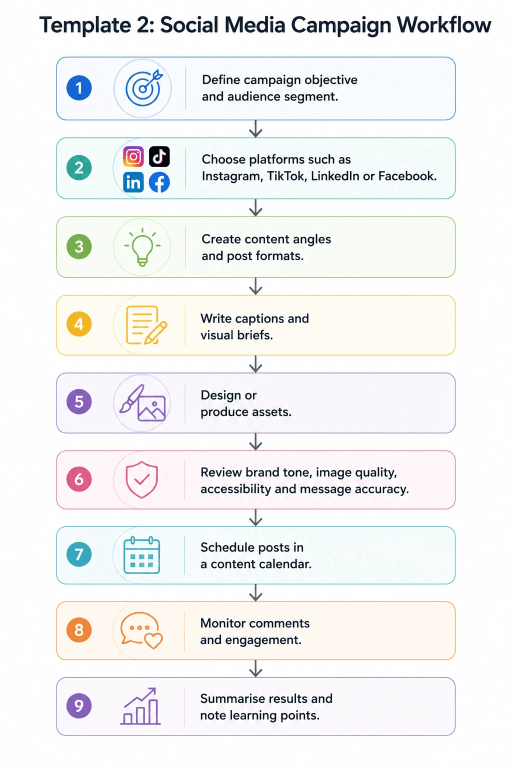
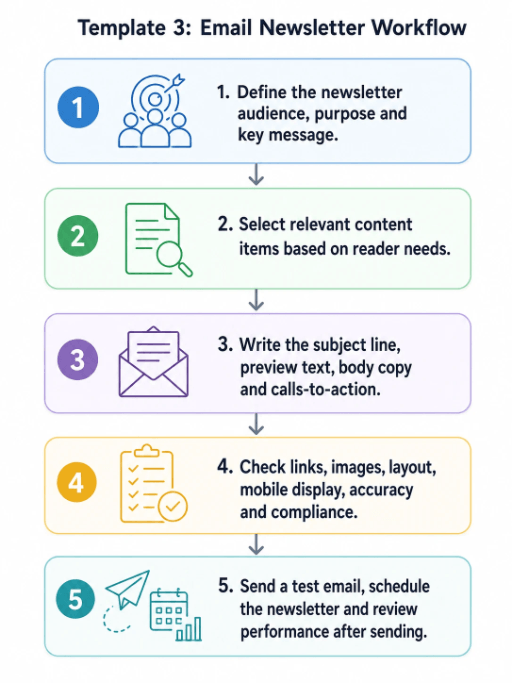
A content marketing workflow template should match the content format, team size and approval needs. The examples below can be adapted for study projects, internships or workplace planning.
Template 1: Blog Article Workflow
.jpg?lang=en-US)
Template 2: Social Media Campaign Workflow
Template 3: Email Newsletter Workflow
Template 4: Video Content Workflow
.jpg?lang=en-US)
Conclusion
A good content marketing workflow is the foundation of strong content. It helps marketing teams create consistent, high‑impact work and turn scattered ideas into strategic assets.
For students, learning this workflow is valuable. If you are interested in developing these marketing foundations, you can explore the Bachelor of Arts (Honours) Marketing offered at SIM to learn how the programme supports students in building relevant knowledge for today’s marketing environment.